
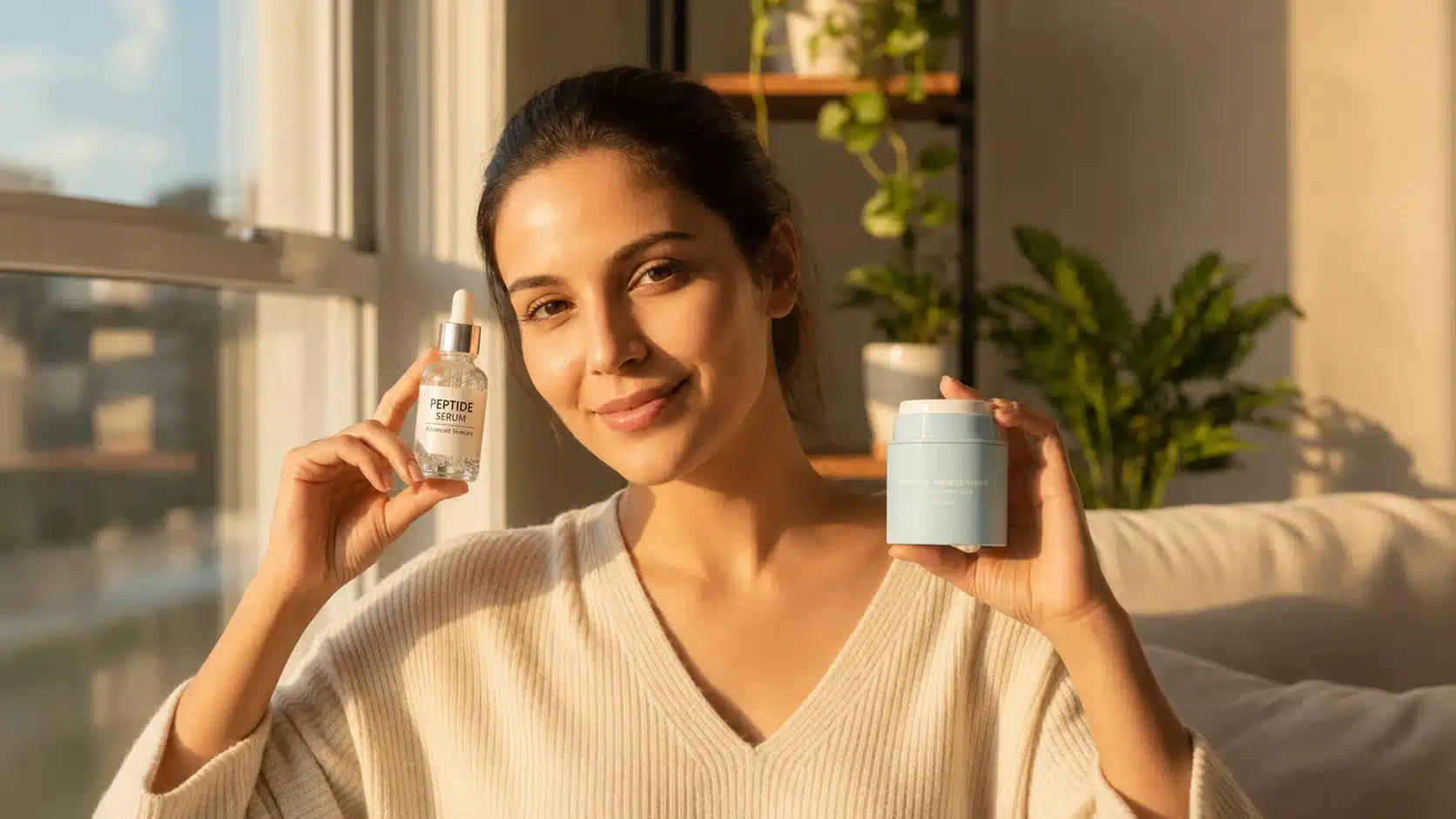
Peptide Serum vs Peptide Moisturiser is one of those beauty questions that sounds simple until you start shopping.
One product says it helps the skin look firmer. Another says it supports the skin barrier. One is lightweight and expensive. Another is creamy and comforting. Some products call themselves peptide treatments, some are peptide creams, some are peptide serums, and some moisturisers include peptides quietly inside the ingredient list.
So which one is actually worth buying?
The honest answer is this: both can be useful, but they do not play the same role.
A peptide serum is usually a more targeted step. It is lighter, often more concentrated, and designed to sit under moisturiser.
A peptide moisturiser is usually a comfort-and-care step. It combines moisturising ingredients with peptides, so it can support the skin barrier while also giving anti-ageing or firm-looking skin benefits.
The best choice depends on your skin, your budget, your current routine and how much effort you realistically want to give your skincare.
Peptide Serum vs Peptide Moisturiser: The Basic Difference
The main difference is texture and purpose.
A peptide serum is usually thin, lightweight and designed to deliver active ingredients before moisturiser. It is often used after cleansing and before cream. Serums are good for women who already have a skincare routine and want to add a more focused treatment step.
A peptide moisturiser is richer. It is designed to hydrate, soften and protect the skin while also including peptides. It works well for women who prefer a simple routine or whose skin feels dry, sensitive, tight or barrier-damaged.
Think of it this way.
- A peptide serum says: “I am a treatment step.”
- A peptide moisturiser says: “I am a moisturising step with added skincare benefits.”
Neither is automatically better. The right one is the one your skin will tolerate and you will use consistently.
What Are Peptides in Skincare?
Peptides are short chains of amino acids. Amino acids are building blocks of proteins, and proteins such as collagen and elastin help skin look firm, smooth and resilient.
In skincare, peptides are used because they can support the appearance of smoother, firmer and healthier-looking skin. They are often found in anti-ageing products, barrier-support creams, eye creams, serums and moisturisers.
They are not magic. They will not change your face overnight. But they can be a helpful part of a consistent skincare routine, especially when paired with sunscreen, moisturiser and gentle cleansing.
The key is expectation.
Peptides are more “steady support” than instant transformation.
What Do Peptides Do to the Skin?
Peptides can help skin look smoother, plumper, calmer and more supported over time.
Different peptide types are used for different purposes. Some are included in formulas that aim to support collagen production. Some are used for firmer-looking skin. Some are paired with ingredients that support hydration and barrier repair. Some are used in eye creams to help the under-eye area look less tired.
In simple beauty language, peptides may help with:
- Fine lines.
- Loss of firmness.
- Skin that looks tired.
- Weak or dry skin barrier.
- Texture.
- Early signs of ageing.
- Plumpness.
- Overall skin resilience.
However, peptides work best when the full formula is good. A product is not automatically excellent just because the word peptide appears on the label.
The base formula matters. The concentration matters. The other ingredients matter. The packaging matters. Your skin type matters.
Peptide Serum Benefits
A peptide serum is useful when you want a more targeted skincare step.
It may help skin look smoother and firmer over time. It can layer well under moisturiser. It is often lighter than cream, so it may suit oily, combination or humid-weather skin better than a rich moisturiser.
Peptide serums are also useful when your current moisturiser is already working well and you do not want to replace it.
For example, you may already love your simple moisturiser. Instead of changing the whole routine, you can add a peptide serum underneath it.
A serum may be a good choice when:
- Your skin tolerates multiple steps.
- You want a more active routine.
- You already use sunscreen daily.
- Your moisturiser is basic but effective.
- Your skin is oily or combination.
- You prefer lightweight textures.
- You want to target early fine lines or firmness without using a heavy cream.
A peptide serum is not necessary for everyone, but it can be a smart upgrade when the rest of your routine is already stable.
Peptide Moisturiser Benefits
A peptide moisturiser is useful when you want one product to do more than one job.
It moisturises the skin while also giving peptide benefits. This makes it practical for women who do not want a long routine or who forget extra serum steps.
A good peptide moisturiser may help the skin feel softer, smoother and more comfortable. It can support the skin barrier, reduce dryness and make the face look more rested. It may also be a better fit for dry, sensitive or mature skin that needs comfort as much as treatment.
A peptide moisturiser may be a good choice when:
- Your skin feels dry or tight.
- Your barrier feels weak.
- You want a simple routine.
- You do not want to buy many products.
- You are new to peptides.
- Your skin becomes irritated easily.
- You want anti-ageing support without a strong active.
- You prefer cream textures.
For many women, a peptide moisturiser is the easier first purchase because it replaces a product you already use: moisturiser.
Which One Is Worth Buying First?
For most beginners, a peptide moisturiser is the more practical first buy.
Why?
Because every skincare routine needs a moisturiser, but not every routine needs a serum. A peptide moisturiser gives you hydration, barrier support and peptide benefits in one step.
This is especially useful when your routine is simple: cleanser, moisturiser, sunscreen.
But a peptide serum may be more worth it when you already have a moisturiser you love and want to add a targeted anti-ageing or firmness-support step.
Here is the simple guide:
- Choose peptide serum if your routine is already good and you want an extra treatment.
- Choose peptide moisturiser if your routine is basic and you want one product that does more.
- Choose both only when your skin needs it, your budget allows it and your routine can stay consistent without becoming heavy.
Do not buy both just because the trend is loud.
Can You Use Peptide Serum and Peptide Moisturiser Together?
Yes, you can use both, but it is not always necessary.
Using both may be fine when the formulas are gentle, your skin is dry or mature, and your routine is built around barrier support and anti-ageing. But doubling peptide products does not automatically double results.
Sometimes it only doubles cost.
A simple routine would be:
- Cleanser.
- Peptide serum.
- Peptide moisturiser.
- Sunscreen in the morning.
At night, the same routine can work without sunscreen.
But if you also use retinol, vitamin C, exfoliating acids or acne treatments, introduce peptide products carefully. Too many new products at once can make it difficult to know what is helping and what is irritating your skin.
Peptides are often considered gentle, but the full formula may still include ingredients your skin dislikes.
What Are the Best Peptides for Skin?
There are many peptide types in skincare, and most women do not need to memorise every scientific name.
Still, it helps to understand the common categories.
- Signal peptides are often used in products that aim to support collagen and firmer-looking skin.
- Carrier peptides help deliver certain minerals, such as copper, in some skincare formulas.
- Neurotransmitter-style peptides are used in some products that claim to soften the look of expression lines.
- Enzyme-inhibitor peptides are used in formulas that aim to reduce the breakdown of collagen-supporting structures.
Some popular ingredient names shoppers may see include palmitoyl tripeptide, palmitoyl tetrapeptide, copper peptides, acetyl hexapeptide and peptide complexes.
But the ingredient name alone is not enough.
Look for a well-formulated product that suits your skin type. Peptides work best when combined with supportive ingredients such as ceramides, hyaluronic acid, glycerin, niacinamide or barrier-friendly moisturisers.
For a simple explanation of what peptides do in skincare, ingredient education pages can be useful, but your final decision should still depend on your skin and routine.
Best Peptides for Skin Tightening: What to Expect
Many products use the phrase “skin tightening”, but it needs to be understood carefully.
Peptides may help skin look firmer, smoother and more elastic over time. They may support the appearance of better texture and plumpness. But they will not give the same result as professional treatments, injectables or surgery.
For mild early firmness concerns, peptide products can be useful.
For deeper sagging, they may support the routine but should not be expected to lift the face dramatically.
The best peptide skincare for firmer-looking skin usually has:
- A good peptide complex.
- Hydrating ingredients.
- Barrier-support ingredients.
- A comfortable texture.
- Consistent use.
- Sunscreen in the daytime routine.
Without sunscreen, anti-ageing skincare becomes less effective because sun damage continues to break down the look and quality of the skin.
Peptide Serum Side Effects
Peptide serums are generally well tolerated, but side effects can still happen.
The most common issue is not always the peptide itself. It may be the formula.
Some women may experience redness, itching, stinging, breakouts, small bumps, dryness or irritation. This can happen if the serum contains fragrance, essential oils, strong actives, alcohol-heavy textures or ingredients that do not suit your skin.
A peptide serum may also pill under moisturiser or makeup if the texture does not layer well.
To reduce risk, patch test first. Introduce it slowly. Do not start multiple new products in the same week. Stop using it if irritation continues.
For sensitive skin, choose fragrance-free and simple formulas where possible.
Peptide Moisturiser Side Effects
Peptide moisturisers can also cause side effects depending on the formula.
A rich peptide moisturiser may feel heavy on oily or acne-prone skin. It may clog pores for some users, especially if the texture is too occlusive. Some moisturisers may cause stinging if the skin barrier is already damaged.
Fragrance, essential oils and heavy butters can also irritate some skin types.
The most common problems are:
- Breakouts.
- Greasy feeling.
- Small bumps.
- Stinging.
- Redness.
- Itching.
- Pilling under sunscreen.
- Feeling too heavy in humid weather.
This does not mean peptide moisturisers are unsafe. It means texture matters.
A dry-skin user may love a rich peptide cream. An oily-skin user may prefer a gel-cream or a peptide serum instead.
Peptides vs Retinol: Which Is Better?
Peptides and retinol are different.
Retinol is more established for visible signs of ageing, texture and cell turnover, but it can cause dryness, peeling, sensitivity and irritation, especially at the beginning.
Peptides are usually gentler. They may support firmer-looking skin and barrier comfort, but results are usually more subtle.
This makes peptides useful for women who cannot tolerate retinol, are new to anti-ageing skincare, or want a gentler supporting product.
Some routines can include both, but they should be introduced carefully.
For example, retinol can be used on some nights, while peptides can support the skin on alternate nights or in a moisturiser. The exact routine depends on your skin’s tolerance.
Peptides are not a replacement for sunscreen, and retinol is not suitable for everyone.
Peptide Serum vs Peptide Moisturiser for Different Skin Types
For oily skin, a peptide serum may feel better than a rich moisturiser. Use a lightweight gel moisturiser over it, especially in humid climates.
For dry skin, a peptide moisturiser may be more satisfying because it gives comfort and barrier support.
For sensitive skin, a simple peptide moisturiser may be easier than a serum with many active ingredients. Look for fragrance-free formulas.
For combination skin, a peptide serum plus a light moisturiser may work well.
For mature skin, either can be useful. A peptide serum under a moisturiser may give a more complete routine.
For acne-prone skin, avoid heavy creams unless they are non-comedogenic and comfortable for your skin.
For South Asian skin tones, the same peptide rules apply, but irritation should be taken seriously because inflammation can sometimes leave marks or uneven tone. For broader beauty care rooted in skin and hair traditions, Satynmag’s article Best Guide for South Asian Skin and Hair in Tradition is a useful extra read.
How to Use Peptide Products Correctly
Use peptide serum after cleansing and before moisturiser.
Use peptide moisturiser after serum or as your main cream.
In the morning, always finish with sunscreen. In the evening, finish with moisturiser if your serum is not enough.
A simple morning routine:
- Gentle cleanser.
- Peptide serum or peptide moisturiser.
- Sunscreen.
A simple night routine:
- Gentle cleanser.
- Peptide serum.
- Peptide moisturiser or regular moisturiser.
Consistency matters more than applying too much product. A pea-sized amount of moisturiser may be enough for some women, while dry skin may need more.
Follow the product instructions and avoid layering too many strong actives at once.
What to Check Before Buying
Before buying a peptide serum or moisturiser, check these points.
- Does it suit your skin type?
- Is it fragrance-free or low-irritation?
- Does the formula include supportive ingredients such as glycerin, hyaluronic acid, ceramides or niacinamide?
- Is the product realistic for your budget?
- Will you use it consistently?
- Does it fit your routine?
- Are the claims reasonable?
Be careful with products that promise instant lifting, dramatic tightening or “Botox-like” results from a cream alone.
Beauty marketing can be exciting, especially when peptide products become trendy. Satynmag’s article Why Are Young Women Obsessed With Rhode? is a useful extra reading option if you enjoy understanding why certain skincare trends become so popular.
A good peptide product should make sense for your skin, not only for your Instagram feed.
So, Which One Should You Buy?
Buy a peptide serum when you want a targeted step and already have a moisturiser you like.
Buy a peptide moisturiser when you want a simpler routine and need hydration as much as anti-ageing support.
Buy both only when your skin tolerates layered products and your routine is already stable.
Skip both for now if your routine does not yet include sunscreen. Sunscreen should come before anti-ageing extras because sun exposure is one of the biggest reasons skin develops premature fine lines, pigmentation and loss of firmness.
The most valuable skincare routine is not always the most expensive one.
It is the one that is consistent, gentle and built around your skin’s real needs.
It is about what your skin actually needs
Peptide Serum vs Peptide Moisturiser is not about which product is more fashionable.
It is about what your skin actually needs.
A peptide serum is better for targeted support, lightweight layering and women who already have a steady routine. A peptide moisturiser is better for simplicity, hydration, barrier comfort and anyone who wants one product to do more.
Peptides can help skin look smoother, firmer, plumper and more supported, but they need realistic expectations and consistent use. They are not instant face-lift products, and they do not replace sunscreen, sleep, hydration or a gentle routine.
Start with the product that solves your real problem: serum for targeted treatment, moisturiser for comfort and simplicity.
That is how to make peptides worth buying.
For more skincare, beauty and style guides, explore Satynmag’s Fashion & Beauty section.