
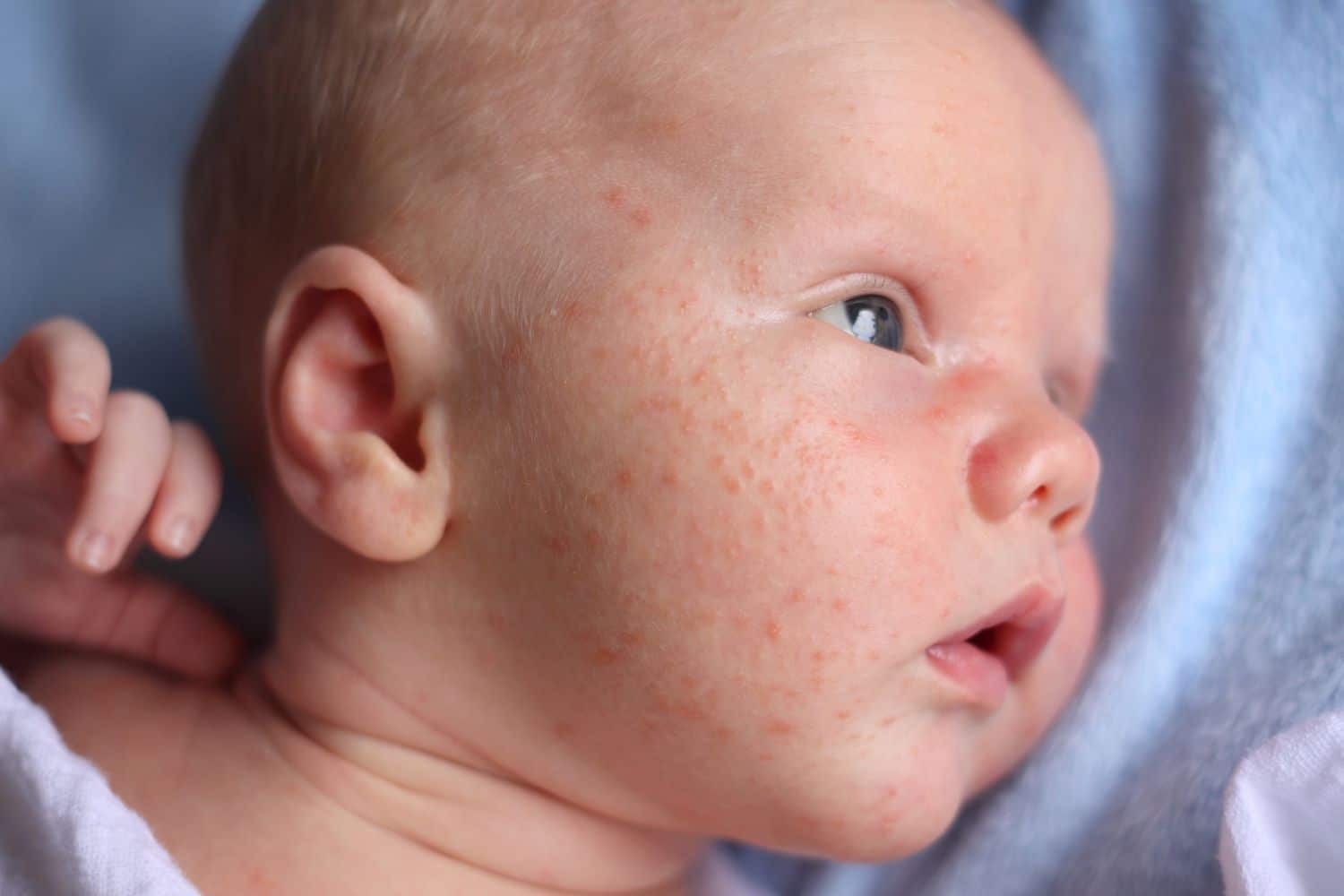
Newborn Acne vs Eczema vs Heat Rash can become a surprisingly stressful comparison when you are holding a tiny baby with a face full of bumps and three different internet searches are telling you three different things.
Perhaps the spots appeared overnight. Yesterday those cheeks were smooth; this morning there are tiny red bumps around the nose and forehead. Or perhaps the skin feels rough and dry rather than spotty. Then someone tells you it must be the heat because the same little bumps have appeared around the neck.
Baby skin changes constantly during the first months of life, and many common rashes are harmless. The useful thing is not to become an expert dermatologist overnight, but to know which clues matter: what the rash looks like, how the skin feels, where it appears, when it started and whether your baby seems bothered by it. That little bit of clarity can make those early weeks considerably less overwhelming when you are already learning everything else that comes with being a new mom.
The Quick Visual Comparison: Newborn Acne vs Eczema vs Heat Rash
These three conditions can overlap in appearance, especially on the face, but they usually behave differently.
| What to notice | Newborn acne | Eczema | Heat rash |
|---|---|---|---|
| Typical look | Small red or white pimple-like bumps | Dry, rough, scaly or inflamed patches | Many tiny raised bumps or small clear blisters |
| Common timing | Often around 2–4 weeks after birth | Often begins after the earliest newborn weeks, commonly in the first months | Can appear whenever baby becomes hot or sweaty |
| Common places | Cheeks, nose, forehead, chin; sometimes neck, chest or back | Cheeks, forehead and scalp; later arms and legs | Neck folds, hairline, chest, back, armpits and covered areas |
| How it feels | Usually not especially itchy | Often itchy and uncomfortable | May feel prickly or itchy |
| Biggest clue | Looks like tiny pimples | Dryness and itch are prominent | Appears after heat or sweating |
| Usually helped by | Gentle care and time | Moisturising and appropriate eczema care | Cooling the baby and skin |
This is a guide, not a diagnosis. A photograph alone can be misleading, particularly because redness can look very different across skin tones.
When the Cheeks Suddenly Look Like a Teenage Breakout
Newborn acne usually appears during the first six weeks of life, commonly around two to four weeks after birth. The cheeks and nose are classic places to notice it, although the forehead, chin, scalp, neck, chest or upper back can also develop bumps.
It tends to look like small red or white pimples rather than one continuous dry patch. The skin between the bumps may look fairly normal, and the baby is usually not desperately trying to rub or scratch the area.
The reassuring part is that newborn acne generally clears by itself over the following weeks or months and rarely scars. You do not need to squeeze the spots, scrub them away or reach for the acne products in your own bathroom cabinet.
Adult acne washes, acids and spot treatments are not appropriate for newborn skin unless a doctor specifically recommends something. Gentle washing with lukewarm water and leaving the spots alone is usually enough.
One useful age clue is that acne beginning after six weeks is considered differently from typical neonatal acne. If a new acne-like breakout starts later, especially around three to six months, it is worth showing your baby’s healthcare professional because infantile acne can behave differently and sometimes needs treatment.
Eczema Usually Feels Different Before It Looks Different
Eczema can also appear on the cheeks, which is exactly why parents confuse it with baby acne.
The texture is often the giveaway.
Instead of separate little pimples sitting on otherwise normal skin, eczema tends to create areas that feel dry, rough, flaky or scaly. The skin may look inflamed and, during a stronger flare, can become weepy or crusted.
Itching is another important clue. A very young baby cannot tell you that her cheek is itchy, but she may seem unusually restless, rub her face against bedding or clothing, or become irritated when the skin is touched.
In babies, eczema commonly affects the cheeks, forehead and scalp and may later involve the arms and legs. It often begins during the first few months rather than appearing immediately after birth.
On darker skin, eczema may not look bright red. The affected area may look darker, grey, purple or simply more bumpy and dry than the surrounding skin. Looking at texture and behaviour, rather than searching only for redness, can therefore be much more useful.
What Actually Helps Eczema?
Eczema care is very different from acne care because dryness is part of the problem.
Gentle, fragrance-free moisturisers or ointments can help protect the skin barrier. Baths should be comfortably warm rather than hot, and harsh soaps, fragranced products and irritating fabrics can make sensitive skin more uncomfortable.
This is also not the moment to experiment with essential oils, herbal pastes or several new baby products at once. When something irritates the skin, using five products makes it much harder to work out which one caused the reaction.
If the eczema becomes very inflamed, persistently itchy, weepy or crusted, speak with your baby’s healthcare professional. Prescription or medicated creams can sometimes be needed, but the right treatment and strength should be chosen for an infant rather than borrowed from somebody else’s eczema routine.
Heat Rash Has One Very Helpful Clue: What Happened Before It Appeared?
A baby wakes after a warm nap with dozens of tiny bumps around the neck.
Or you remove several layers of clothing after a hot afternoon and notice spots across the upper chest and back.
That pattern points much more strongly towards heat rash.
Babies do not regulate heat as efficiently as adults, and blocked sweat ducts can produce clusters of very small raised bumps. Some look red, while others may resemble tiny clear fluid-filled blisters. On darker skin, the colour may be much less obvious, so the texture becomes particularly useful.
Heat rash likes warm, covered areas. Think neck folds, hairline, upper chest, back, armpits, underneath clothing and sometimes around the nappy area.
The baby may seem slightly itchy or uncomfortable, but the rash should begin improving once the skin is kept cool.
Cooling Works Better Than Covering Heat Rash in Cream
The instinct when you see irritated baby skin is often to put something on it.
With heat rash, the better first move is usually to take something off.
Remove unnecessary layers, move the baby somewhere cooler and use loose, breathable clothing. A cool or comfortably lukewarm bath can help, as can allowing sweaty skin folds to dry properly.
Avoid coating the affected areas in thick greasy ointments unless a healthcare professional has recommended them. Heavy products can trap heat and further block sweat ducts.
This is particularly relevant in warm climates or during hot seasons, when babies can become overheated simply because adults assume they always need an extra layer.
A useful rule is to check the baby’s chest or back rather than judging temperature from hands and feet alone.
The Location Can Solve Half the Mystery
If the rash is almost entirely on the cheeks and nose and looks pimple-like in a three-week-old baby, acne becomes a strong possibility.
If those cheeks are rough, dry and itchy, eczema moves higher on the list.
If tiny bumps suddenly appear around a sweaty neck fold, hairline and upper chest after a hot day, heat rash makes more sense.
But location is never enough by itself because all three can appear around the face or upper body.
That is why the best home comparison uses several clues together: age + appearance + texture + location + baby’s behaviour + what happened before the rash appeared.
That combination is much more useful than comparing one photograph with another at midnight.
Not Every Tiny White Bump Is Acne Either
There are a few other normal newborn skin changes worth knowing because they can easily enter this comparison.
- Milia are tiny white bumps commonly seen around the nose, chin and cheeks. They are small cysts rather than acne and usually disappear without treatment. Do not squeeze them.
- Erythema toxicum is another very common newborn rash that can appear within the first few days of life. It often looks blotchy with small spots and usually disappears on its own while the baby remains perfectly well.
- Cradle cap looks different again, producing greasy or scaly patches over the scalp and sometimes around the eyebrows or ears.
A baby’s first months can therefore contain several completely ordinary skin changes. Having more than one type at different times is not unusual.
Three Things Not to Do While You Are Figuring It Out
- First, do not squeeze, pick or scrub bumps. Newborn skin is delicate, and irritation can make an innocent rash look much worse.
- Second, avoid turning the baby’s face into a testing ground for internet remedies. Toothpaste, lemon, essential oils, strong herbal mixtures and adult skincare products can irritate or damage infant skin.
- Third, do not assume that every rash needs cream. Acne often needs very little intervention, eczema generally benefits from moisturising, while heat rash primarily needs cooling. Treating all three in exactly the same way is where confusion often starts.
When you are uncertain, taking a clear photograph in natural light can be useful for showing your baby’s healthcare professional, particularly if the rash later changes.
When It Is No Longer a “Which Rash Is This?” Question
Most newborn rashes are harmless, but a very young baby can also become unwell quickly. There are moments when you should stop comparing photographs and seek medical help.
A baby under three months with a temperature of 38°C or higher needs prompt medical assessment. A rash that looks like small bruises or bleeding under the skin and does not fade when pressed also needs urgent attention.
Seek medical help promptly if your baby seems unusually sleepy or difficult to wake, is feeding poorly, has breathing difficulty, develops sudden swelling, appears very unwell or has a rapidly worsening rash.
Blisters, spreading redness, pus, significant crusting or skin that looks infected also deserve medical advice.
And there is one rule new parents sometimes need permission to follow: if the rash simply does not look right to you, ask. You do not have to wait until you can name it correctly before speaking to someone.
The Simplest Way to Remember the Difference
Newborn Acne vs Eczema vs Heat Rash becomes much easier when you stop looking only at colour.
Acne is usually pimply and early. Eczema is usually dry and itchy. Heat rash is usually tiny, clustered and connected to warmth or sweating.
There will always be exceptions, which is why your baby’s age, comfort and general health matter just as much as the bumps themselves.
Most importantly, do not feel that every change in newborn skin is something you caused. Babies are adjusting to an entirely new environment, and temporary spots, dry patches and rashes are incredibly common during that process.
For more reassuring, practical guides through newborn care and early motherhood, explore Satynmag’s Mom & Baby section. For a closer medical comparison of baby eczema and acne, this medically reviewed guide also explains how their appearance and timing can differ.