In profile
Four Sri Lankan Women Scientists Recognised in Landmark Asian STEM Book
From fighting tropical diseases to opening digital education, building telecommunications systems and protecting our oceans, four Sri Lankan women have earned regional recognition for science that reaches far beyond the laboratory.
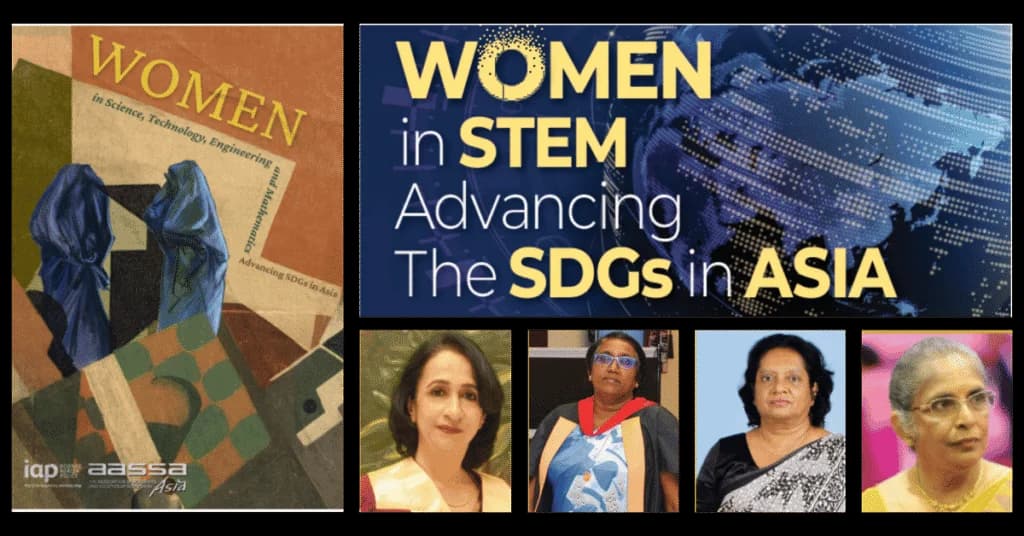
Four Sri Lankan Women Scientists have been recognised in Women in Science, Technology, Engineering and Mathematics (STEM): Advancing SDGs in Asia, a 2026 publication from the Association of Academies and Societies of Sciences in Asia.
The book brings together 49 women scientists, engineers and educators from 14 Asian countries whose work contributes directly to the United Nations Sustainable Development Goals.
Sri Lanka’s four representatives could hardly be more different in their fields. One studies diseases that affect some of the world’s most vulnerable communities. Another has helped open university-level learning to thousands of people through technology. One has spent decades advancing telecommunications and digital infrastructure. The fourth helped build an entire academic field around fisheries and marine science.
Professor Nadira Karunaweera, Senior Lecturer Vishaka Nanayakkara, Professor Dileeka Dias and Professor Emerita Ruchira Cumaranatunga were nominated by the National Academy of Sciences of Sri Lanka for the publication.
And when you look properly at what each of them has done, the recognition feels bigger than four impressive CVs. Their careers show what science looks like when it is applied to real problems.
Professor Nadira Karunaweera: Science That Reaches the Patient
Professor Nadira Karunaweera’s work sits at the point where laboratory science meets public health.
She is Chair and Senior Professor of Parasitology at the Faculty of Medicine, University of Colombo and has built an internationally recognised career studying tropical and vector-borne diseases, particularly malaria and leishmaniasis.
Leishmaniasis is a parasitic disease spread through the bite of infected sandflies. It is classed among neglected tropical diseases, a group that disproportionately affects communities where access to diagnosis and treatment may already be limited.
Karunaweera was responsible for pioneering work on leishmaniasis in Sri Lanka and establishing the country’s first diagnostic and research laboratory dedicated to the disease.
Her research has covered how the parasite spreads, how disease develops, its epidemiology, diagnosis and possible approaches to control. She has also led international research collaborations involving Sri Lanka and Bhutan.
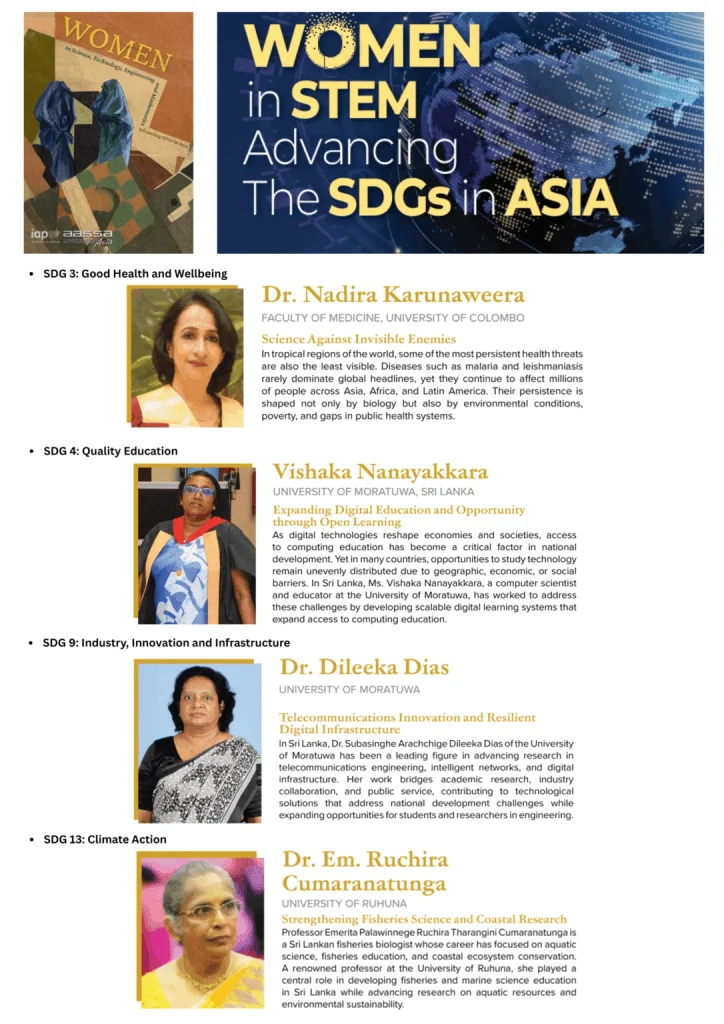
It is this body of work that places her contribution within SDG 3: Good Health and Well-being.
But there is another part of her career young scientists should notice.
She did not limit herself to research.
Karunaweera became the first Sri Lankan elected as an International Honorary Member of the American Academy of Arts and Sciences. She was elected a Fellow of The World Academy of Sciences in 2021 and has held leadership roles within the National Academy of Sciences of Sri Lanka.
She also founded the Sri Lankan National Chapter of the Organization for Women in Science for the Developing World, creating opportunities for younger scientists, particularly women, to develop their careers.
That combination matters. Doing excellent science is one achievement. Creating space for the scientists coming behind you is another.
Senior Lecturer Vishaka Nanayakkara: What If University Could Reach the Student?
Senior Lecturer Vishaka Nanayakkara’s contribution asks a very different question.
What happens to talented young people who cannot enter a conventional university programme?
Nanayakkara is a Senior Lecturer Grade I in Computer Science and Engineering at the University of Moratuwa and Director of its Centre for Open & Distance Learning.
Her academic path began with a First Class Honours engineering degree in Computer Science and Engineering from the University of Moratuwa in 1994. She later completed a Technical Licentiate in Computer Engineering at Chalmers University of Technology in Sweden.
She eventually served as Head of the Department of Computer Science and Engineering from 2005 to 2011, but much of the work for which she is now being recognised goes beyond a physical classroom.
Nanayakkara has been closely involved with the development of the University’s open learning system, including open.uom.lk, which has made online courses and educational resources available to learners outside traditional university pathways.
That is why her contribution is connected to SDG 4: Quality Education.
This work matters particularly in a country where university places have traditionally been limited.
Digital education cannot replace every part of campus life, but it can remove barriers created by geography, work, family responsibilities or lack of access to conventional higher education.
The University of Moratuwa’s open learning initiatives have also received international recognition, including awards for educational technology.
Nanayakkara’s story is a useful reminder that working in technology does not necessarily mean building the newest device.
Sometimes innovation is asking who has been left outside the system, then using technology to open the door.
Continue your growth
Turn useful reading into career momentum.
Explore expert resources, workshops and professional support inside Satyn Circle.
Join Satyn CircleProfessor Dileeka Dias: Building the Networks Modern Life Depends On
Every time we use mobile communication, location technology, connected devices or digital infrastructure, we are relying on engineering most of us rarely see.
Professor Dileeka Dias has spent decades working inside that world.
A graduate of the University of Moratuwa in Electronic and Telecommunication Engineering, she later completed postgraduate studies at the University of California, earning a Master’s degree in Electrical Engineering and Computer Science and a PhD in Digital Mobile Communications.
Her research has covered wireless positioning, mobile computing, wireless sensor networks, Internet of Things systems, intelligent transport and disaster communications.
The AASSA publication recognises this contribution under SDG 9: Industry, Innovation and Infrastructure.
But Dias’s career also shows what happens when technical expertise grows into institutional leadership.
She has headed the Department of Electronic and Telecommunication Engineering, served as Dean of the Faculty of Information Technology and became the founding Dean of the Faculty of Graduate Studies.
In May 2026, she was appointed Deputy Vice-Chancellor of the University of Moratuwa, after serving as Acting Deputy Vice-Chancellor earlier in the year.
Her national contributions have included work related to quality standards for broadband and mobile communication services as well as higher-education policy.
She has also received multiple National Science and Technology Awards, University of Moratuwa research awards and the Zonta Woman of Excellence Award in Engineering.
What makes her story especially interesting is the length of it.
Technology changes almost absurdly fast. A telecommunications engineer who began her career in the 1980s has lived professionally through the rise of mobile phones, wireless networks, internet connectivity, IoT and today’s increasingly connected infrastructure.
Remaining relevant through that scale of technological change requires something more than one qualification.
It requires the willingness to keep learning.
Professor Emerita Ruchira Cumaranatunga: Building a Field Around the Ocean
Professor Emerita Ruchira Cumaranatunga’s story stretches across more than four decades of science and university education.
She joined the University of Ruhuna in 1978 as one of its pioneering academic staff members after graduating in Zoology. A Commonwealth academic scholarship later took her to the University of Aston in Birmingham, where she completed doctoral studies in fish reproductive histology and physiology.
Her research career developed around fisheries biology, aquaculture, coastal ecology and aquatic environments.
Yet perhaps her most visible legacy is institutional.
Cumaranatunga helped develop fisheries biology from a specialised area within zoology into a recognised academic discipline. She contributed to the establishment and development of the Department of Fisheries Biology and was instrumental in the creation of the Faculty of Fisheries and Marine Sciences & Technology at the University of Ruhuna in 2005, later serving as its founder Dean.
For an island nation, that work is hardly academic in the narrow sense.
Fisheries, coastal ecosystems, marine pollution, biodiversity and climate pressures directly affect food, livelihoods and communities.
Her inclusion in the AASSA publication therefore falls under SDG 13: Climate Action, reflecting decades of work related to fisheries science, coastal research and environmental sustainability.
She also became the 69th General President of the Sri Lanka Association for the Advancement of Science in 2013 and only the sixth woman to hold that position at the time.
After more than 40 years at the University of Ruhuna, she retired from full-time university service, but she remains active within Sri Lanka’s scientific community and currently serves on the National Academy of Sciences of Sri Lanka council as its Editor.
Four Sri Lankan Women Scientists, Four Careers, Four Very Different Versions of STEM
Perhaps the most inspiring part of this recognition is how difficult it is to place these four women inside one neat idea of a “scientist”.
- One works with parasites and public health.
- One works with computers and education.
- One is an electronic and telecommunications engineer.
- One built her career around fish, coastlines and marine environments.
That is STEM!
It is not one laboratory coat, one type of degree or one personality.
And their impact is not measured only by journal publications. It can be seen in a diagnostic laboratory, an online learner gaining access to education, a communications system that needs to remain reliable during a disaster, or a university faculty training the next generation of marine scientists.
What Young Women Should Take From Their Stories
None of these careers was built in a year. That is probably the most useful lesson.
Scientific careers are often represented through awards, titles and photographs taken at the end of decades of work. What we do not see as easily are the years of postgraduate study, failed experiments, funding applications, teaching, institutional battles, changing technologies and projects that took years to become useful.
These four careers also show that leadership in STEM is not only about becoming the smartest person in the room.
It is about what you build with what you know.
- Karunaweera built research capacity around disease.
- Nanayakkara widened access to education.
- Dias combined engineering research with institutional leadership.
- Cumaranatunga helped build an academic field and faculty around resources fundamental to an island nation.
That is why this regional recognition matters.
The AASSA book is celebrating scientific achievement, certainly. But it is also showing younger women what a long career in science can eventually become.
Not simply a job in STEM. A body of work that changes what other people are able to do.
For Sri Lanka, having four names in a landmark Asian publication is something to celebrate. The better outcome will be seeing many more names follow them.
Share
Written by
Satyn Editorial