Artificial intelligence is no longer a future-of-work concept. It is already changing how people write, hire, sell, manage, design, communicate, and make decisions at work. But there is a more urgent question hiding under all the excitement: will AI help close the gender gap at work, or will it quietly deepen inequality for women who are already under-supported, underpaid, or underrepresented?
The answer is not simple. AI has the power to remove bias, expand access, improve flexibility, and help more women participate in leadership. At the same time, it can also reinforce discrimination, reward those who already have access, and leave many women behind. This is not just a technology story. It is a story about power, access, training, policy, and who gets included in the future of work.
AI Could Help Women Work Smarter, Faster, and More Flexibly
One of the biggest reasons many professionals are optimistic about AI is that it can reduce repetitive work. Women across industries often carry a disproportionate amount of administrative, emotional, and invisible labour at work — organising, documenting, following up, coordinating, preparing, and smoothing over problems that do not always show up in a job description.
AI tools can help reduce some of that load. Meeting summaries, email drafting, task automation, data sorting, scheduling, research support, and workflow optimisation can save time and mental energy. For women balancing demanding careers with caregiving, family management, or side businesses, that kind of efficiency is not a luxury. It can be a lifeline.
AI can also create new entry points into work. Women returning after a career break, mothers re-entering the workforce, and professionals moving into new industries may find AI tools useful for upskilling, building confidence, and becoming more productive quickly.
✦ Bridging Gaps
Women who have historically had less access to elite networks, mentorship, or high-visibility projects may be able to use AI to bridge certain gaps in output, speed, and professional polish. In theory, this could support more inclusive growth.
But AI Is Not Automatically Fair Just Because It Is Digital
There is a dangerous myth that technology is neutral. It is not. AI systems learn from human-created data, human decisions, human institutions, and human history. If the systems are built on biased data, trained on unequal patterns, or deployed without oversight, they can reproduce the very inequalities they claim to solve.
- Recruitment systems trained on male-dominated hiring patterns may continue favouring candidates who look like the historical norm
- Performance tools designed around narrow productivity assumptions may undervalue collaboration, mentoring, and invisible team contributions
- Promotion decisions increasingly data-driven without context may penalise women for career breaks or non-linear career paths
- A discriminatory manager can be challenged — a flawed algorithm hidden inside a platform is often harder to see, audit, or contest
In other words, AI can scale bias faster than a human manager ever could. And because technology carries an aura of objectivity, biased decisions can become harder to question.
The Real Risk Is Not Just Bias — It Is Exclusion
When people discuss women and AI, they often focus only on whether AI tools are biased. That matters, but another risk is just as serious: who gets left behind when AI becomes a basic workplace skill?
The future gap may not only be between men and women. It may be between women who get access to AI literacy, tools, mentoring, and strategic exposure — and women who do not. Highly educated women in urban corporate jobs may adapt faster. But women in lower-paid roles, informal sectors, traditional workplaces, or underfunded regions may not receive the same support.
That creates a new digital inequality inside the existing gender gap.
Women Are Already Underrepresented in the Systems Shaping AI
If women are not involved in building, testing, governing, and leading AI systems, then workplace AI may continue to reflect narrow perspectives.
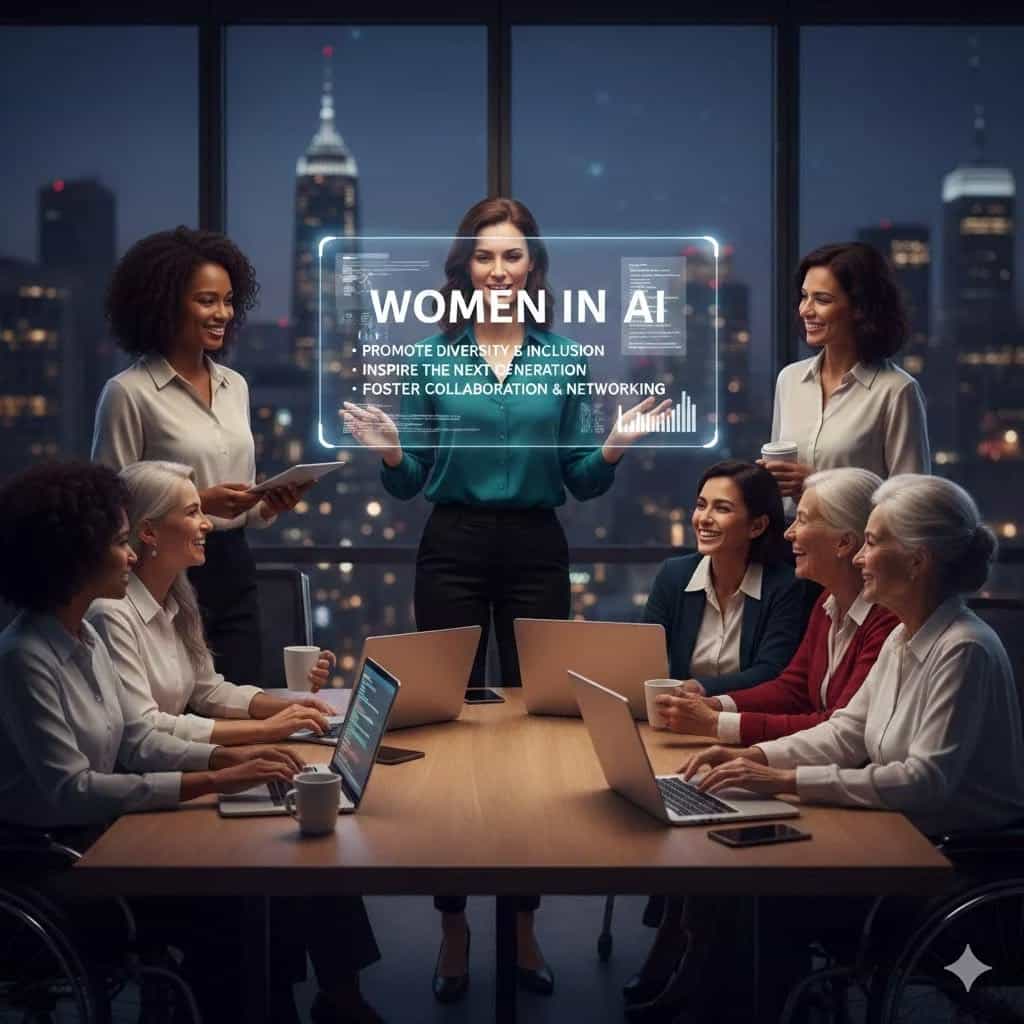
This includes more than coders and engineers. Women need to be involved in AI governance, product design, policy, ethics, HR strategy, operations, law, communication, and executive decision-making. AI affects how workplaces function, so women must have power in deciding how it is implemented.
Representation matters because the people designing tools influence what gets measured, what gets optimised, what risks get noticed, and whose realities are considered normal.
AI May Also Widen Pay and Leadership Gaps
In many organisations, the first people given access to powerful new tools are already senior, already visible, or already trusted. That often means men remain overrepresented among the people who gain early productivity boosts, strategic influence, and promotion advantages from AI.
Mid-career women may be especially vulnerable if they are overloaded with execution work while others get space to experiment, learn, and lead AI-driven transformation.
✦ How Inequality Grows Quietly
This is how inequality often grows in modern workplaces: not through one dramatic discriminatory act, but through quiet differences in access, visibility, sponsorship, and timing.
What Would a Better AI Future for Women Actually Look Like?
A better future will not happen by accident. It will require intentional design. Companies that genuinely want AI to support gender equity need to ask harder questions: Who is being trained? Who is being monitored? Who is being promoted? Who is shaping implementation? Who gets protected when jobs change?
✦
Broad AI Literacy
Training that reaches all levels — not just senior leaders or tech teams. Women in every role should have access to AI education and experimentation.
✦
Transparent Systems
Hiring, performance, and promotion tools that are auditable, explainable, and tested for gender bias before deployment.
✦
Digital Upskilling for Returners
Flexible learning pathways for women re-entering the workforce — ensuring career breaks do not become permanent digital disadvantages.
✦
Human Skills Valued More
As AI handles routine tasks, judgment, empathy, negotiation, creativity, and ethical reasoning become even more critical — and women already contribute heavily here.
The goal should not be to force women to compete with machines. It should be to build workplaces where women can use AI as leverage while their human strengths are finally recognised as business-critical.
The Future of Work Will Reflect the Choices We Make Now
AI can absolutely help close parts of the gender gap at work. It can make work more flexible, reduce invisible labour, open new earning pathways, and lower barriers to entry in many fields.
But it can also do the opposite. If access is unequal, if bias is ignored, if training is limited, if leadership remains male-dominated, and if women are expected to simply "catch up" on their own, AI could widen the gap under the language of progress.
The real question is not whether AI is good or bad for women. The real question is whether workplaces are willing to build an AI future that includes women from the start.
✦ Not an Afterthought
AI is not the solution to workplace inequality. People are. Policy is. Leadership is. Access is. Training is. Accountability is. If the future of work is being rewritten now, women must not be an afterthought in the next draft.
AI & Women
Workplace Equality
Algorithmic Bias
Digital Inclusion
AI Literacy
Gender Gap
Future of Work
Women in Tech
Workplace Feature